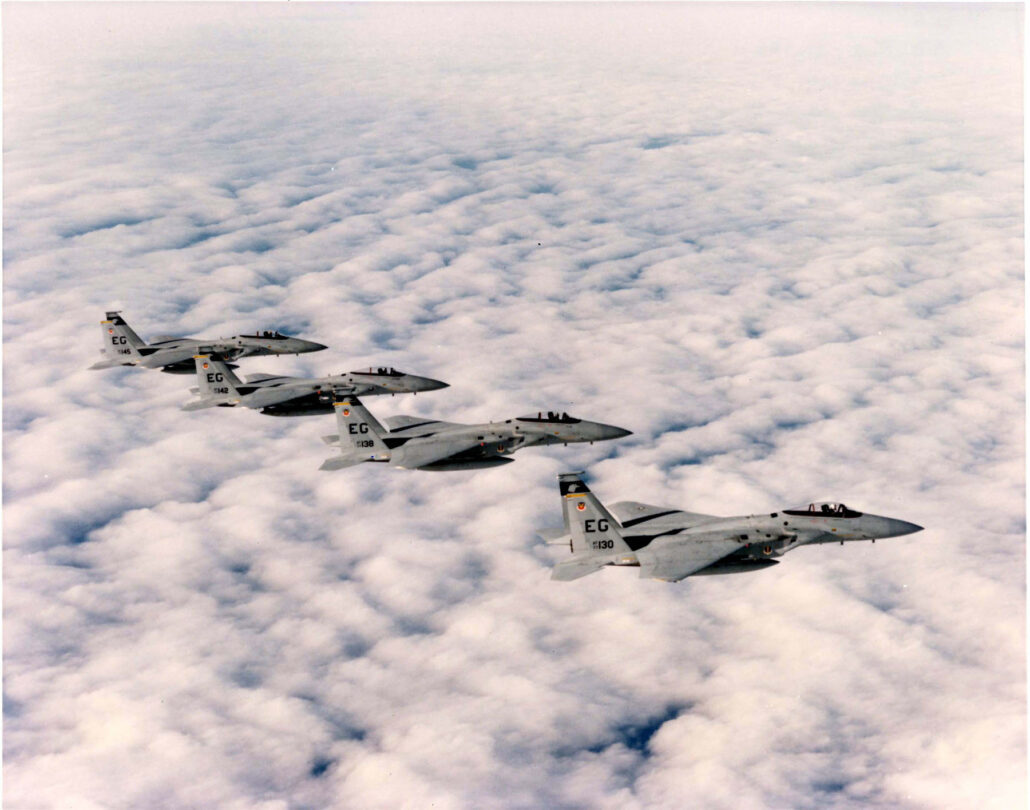
“Golden Pride”
Eagle History
For nearly two decades, the pilots of the 59th Fighter Squadron stood on the front line of American air superiority. Flying the legendary F-15 Eagle from the Gulf Coast skies of Florida to the exercise ranges of Europe, Korea, and Southwest Asia, the squadron helped define what it meant to be an Eagle unit during the Cold War and beyond.
Guardians of NATO’s Southern Flank
During the early 1980s, the Cold War remained very much a military reality. Aircrews of the 59th Tactical Fighter Squadron trained continuously for a potential conflict that many believed could erupt with little warning. Their mission centered on air superiority: defeating enemy fighters, protecting friendly forces, and establishing control of contested airspace.
One of the squadron’s most visible Cold War contributions came through participation in NATO exercises. In 1982, aircraft from the 59th deployed to Europe for the annual REFORGER exercises. These large-scale maneuvers were intended to demonstrate the Alliance’s ability to reinforce Western Europe rapidly in the event of aggression by the Warsaw Pact. Photographs from the exercise show the squadron’s Eagles flying over southern Germany, a powerful symbol of American commitment to NATO during a period of heightened East-West tension.
At the same time, squadron pilots regularly participated in the increasingly sophisticated Red Flag exercises conducted in the western United States. These events provided realistic combat training and helped shape many of the air combat tactics later employed throughout the Eagle community.
The Mature Eagle Force
By the middle of the decade, the 59th had become a fully developed F-15 organization. The squadron participated in numerous joint and combined exercises while refining the tactics that made the Eagle a dominant force in aerial combat.
In 1986, the squadron participated in Exercise Gallant Eagle ’86, a major joint-service training event held at Davis-Monthan Air Force Base, Arizona. Such exercises allowed Eagle crews to operate within large and complex force structures, simulating the conditions they would encounter in wartime.
The late 1980s also saw the squadron operate the improved F-15C and F-15D variants. These aircraft introduced enhanced radar performance, electronic warfare improvements, and other refinements that further strengthened the Eagle’s reputation as the world’s premier air superiority fighter.
Across the Pacific
The squadron’s strategic importance was illustrated once again in 1989 during Exercise Team Spirit in South Korea. Conducted jointly with American and Republic of Korea forces, Team Spirit served as a demonstration of allied preparedness and interoperability. The deployment highlighted the Air Force’s ability to project combat-ready fighter forces rapidly across the Pacific, a capability of continuing importance even after the Cold War.
For the pilots of the 59th, such deployments represented the culmination of years of training. The Eagle had been designed not merely to defend American airspace but to deploy globally and achieve air superiority wherever required.
A New Strategic Environment
The end of the Cold War brought profound changes to the U.S. Air Force. On 1 November 1991, the unit was redesignated as the 59th Fighter Squadron, reflecting organizational changes throughout the service. Although the Soviet threat had disappeared, demand for combat-capable Eagle squadrons remained strong.
Throughout the 1990s, the squadron continued to fly the F-15C/D while adapting to a new operational environment characterized by regional crises and expeditionary deployments. Training increasingly emphasized rapid deployment, coalition operations, and enforcement missions rather than the large-scale European conflict envisioned during the previous decade.
This shift was particularly evident in 1996, when the squadron supported operations associated with Operation Southern Watch and Operation Ceasefire. These missions demonstrated how the Eagle continued to serve as a critical instrument of American power long after the Cold War had ended.
The End of the Eagle Era
On 15 April 1999, the 59th Fighter Squadron was inactivated at Eglin Air Force Base, ending nearly two decades of continuous F-15 operations. For the Airmen who had flown and maintained the Eagle under the squadron’s banner, the inactivation marked the close of a remarkable period in unit history.
The legacy of the squadron’s Eagle years endures. From NATO exercises over Europe to deployments in Korea and Southwest Asia, the 59th helped define what it meant to be an operational F-15 unit during one of the most important periods in modern airpower history. Its pilots trained for a war that never came, adapted to a rapidly changing strategic landscape, and carried the proud traditions of the “Fighting Fifty-Ninth” into the final years of the twentieth century.
(I am looking for more information, any information like squadron rituals, flying anecdotes that you would like to donate please contact the webmaster using on the contact me page)
Squadron photos