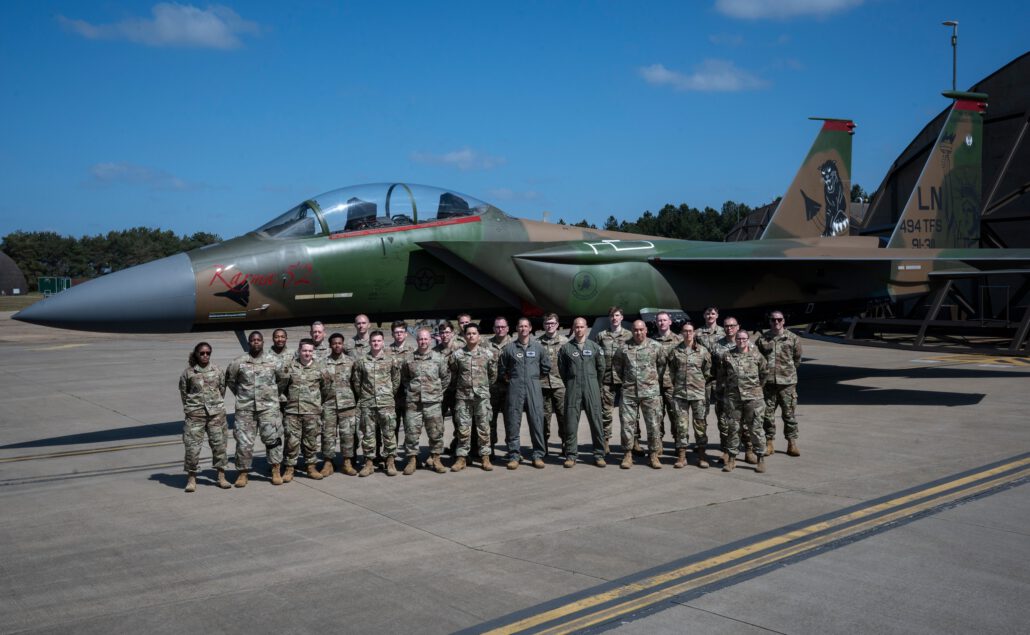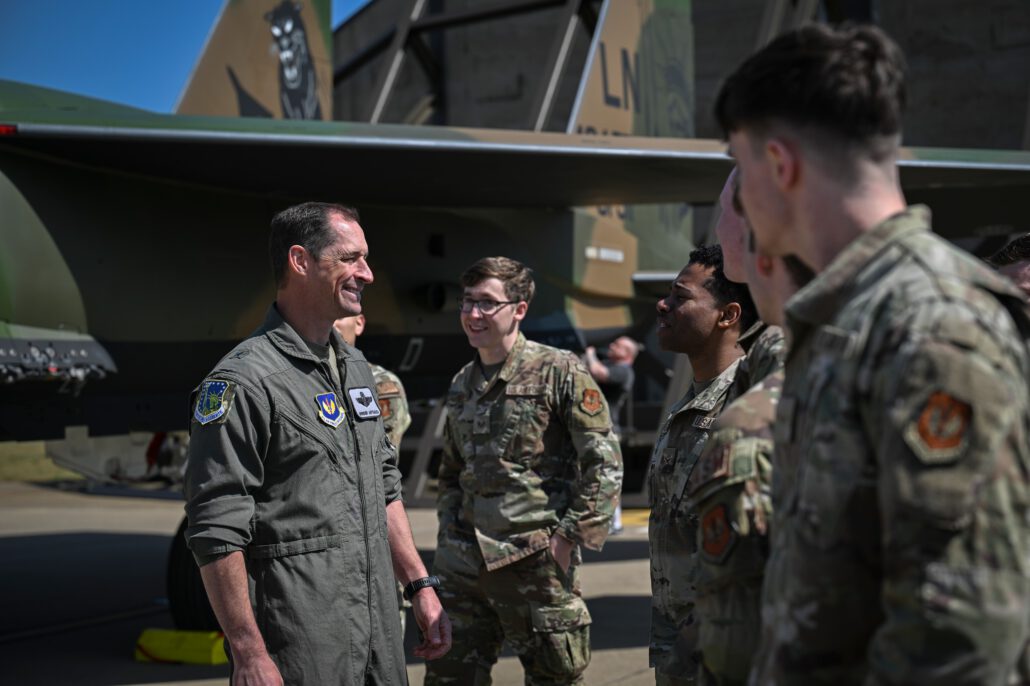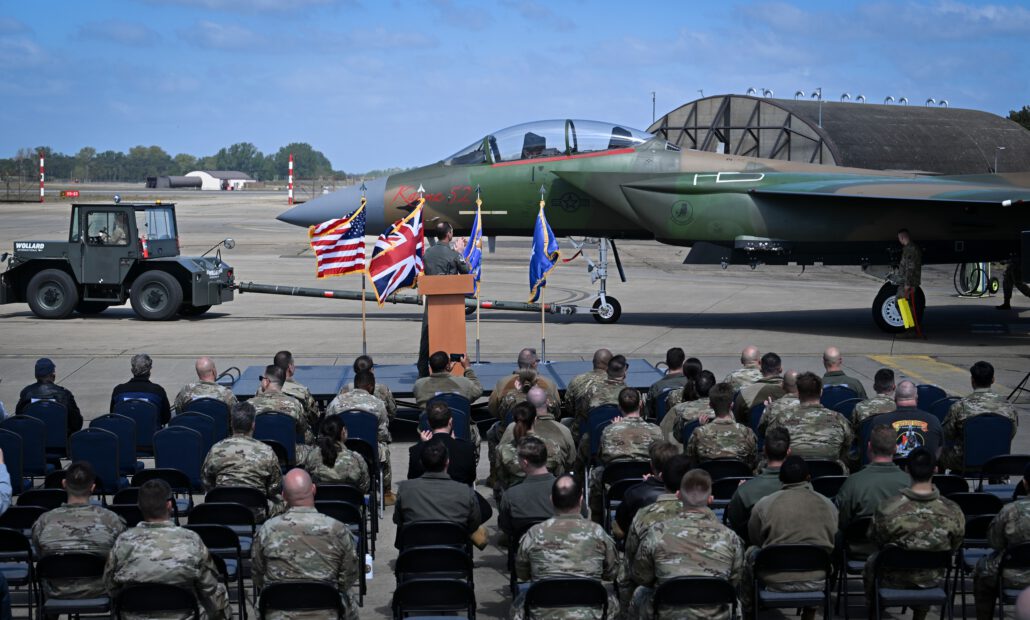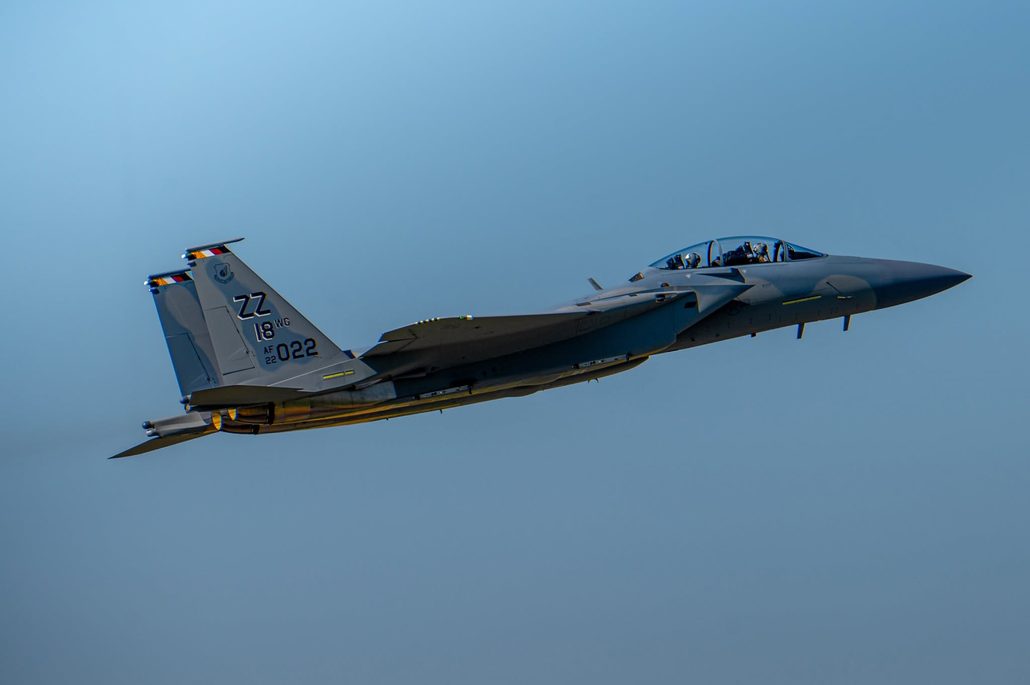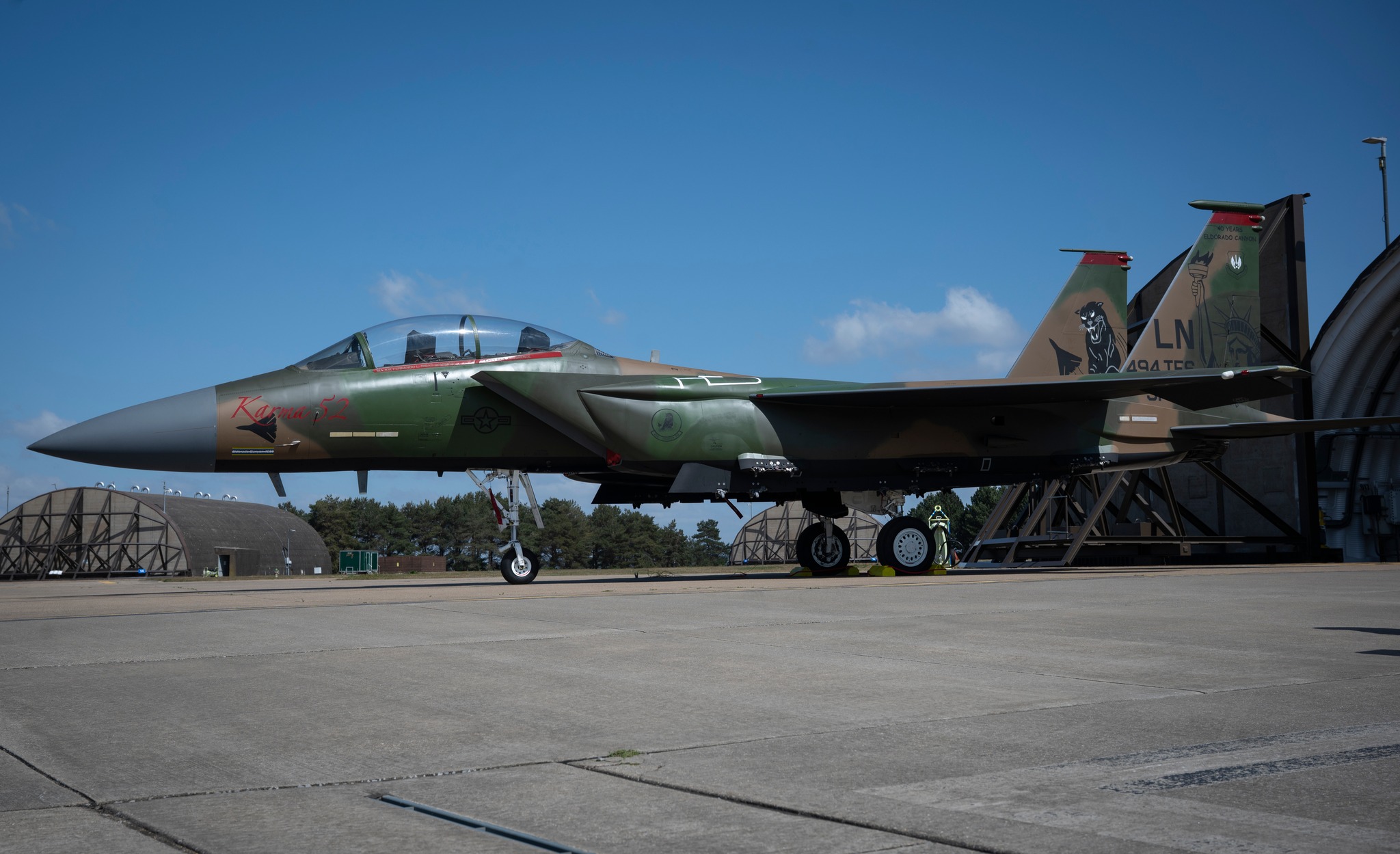
To commemorate the 40th anniversary of Operation El Dorado Canyon, the U.S. Air Force’s 48th Fighter Wing has unveiled a specially painted F‑15E Strike Eagle wearing the historic camouflage once carried by the F‑111F Aardvark.
The unveiling took place during a ceremony at RAF Lakenheath, United Kingdom, home of the 48th Fighter Wing. The heritage jet honors the long‑range strike mission flown from Lakenheath on 14 April 1986, when 24 F‑111Fs of the then‑designated 48th Tactical Fighter Wing launched against targets in Libya.
The aircraft selected for the tribute, F‑15E serial 91‑0311, wears the distinctive three‑tone Southeast Asia–style camouflage applied to the Wing’s F‑111s during the Cold War era. The scheme consists of a tan base complemented by two shades of green, a striking contrast to the Strike Eagle’s usual subdued gray finish. The nose radome remains painted in standard gray, preserving a modern visual cue amid the historic colors.
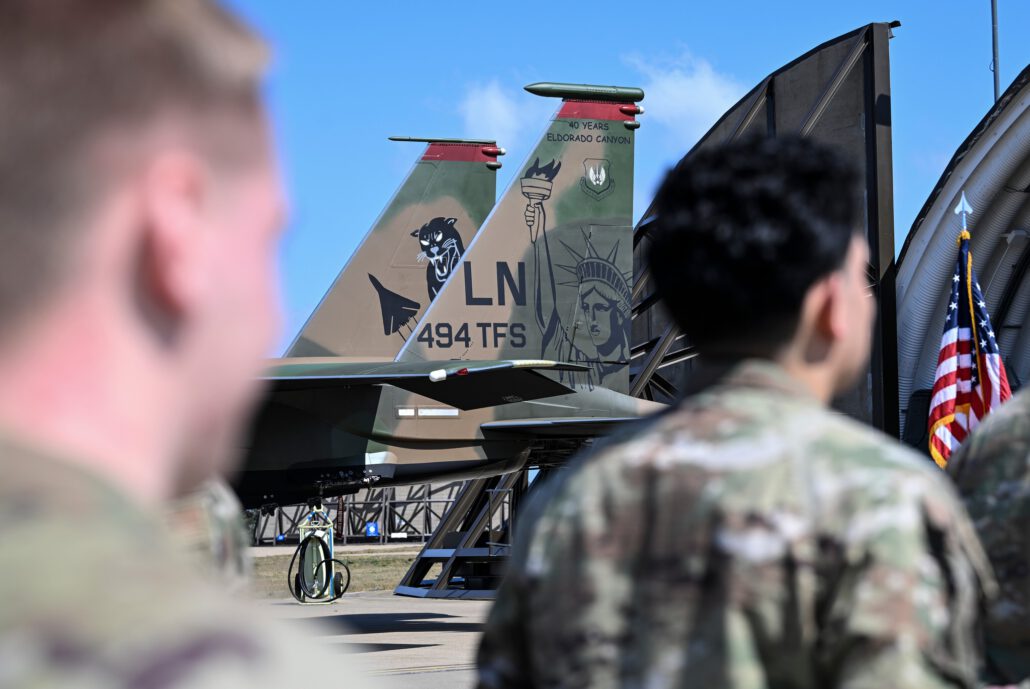
The vertical tails feature a variety of markings reflecting the Wing’s heritage. On the outer surfaces, the familiar “LN” tail flash and aircraft serial are displayed alongside historic markings of the 494th Tactical Fighter Squadron. The upper tail surfaces carry the squadron’s red band and the inscription “40 Years El Dorado Canyon,” while the lower portion showcases the 48th Fighter Wing’s Statue of Liberty emblem, rising upward along the tail.
Additional artwork appears on the inner surfaces of the twin vertical stabilizers, where the silhouette of an F‑111 Aardvark is paired with the panther emblem of the 494th Fighter Squadron, further linking the modern Strike Eagle to its predecessor.
The tribute continues forward on the aircraft’s nose. Here, another outline of an F‑111 is accompanied by the red inscription “Karma 52,” commemorating the only aircraft lost during Operation El Dorado Canyon. F‑111F Karma 52 was flown by Capt. Fernando Ribas‑Dominicci, pilot, and Capt. Paul Lorence, weapons system officer, both of whom were killed during the mission.
Operation El Dorado Canyon
Operation El Dorado Canyon was launched in April 1986 following a terrorist bombing at a discotheque in West Berlin that killed two U.S. servicemen. U.S. President Ronald Reagan ordered retaliatory strikes against Libya, which the United States accused of sponsoring the attack. The operation was carried out jointly by the U.S. Air Force and U.S. Navy.
On the evening of 14 April, 24 F‑111F aircraft lifted off from RAF Lakenheath, supported by five EF‑111A Raven electronic warfare aircraft from the 42nd Electronic Combat Squadron at RAF Upper Heyford. Following the first aerial refueling, six F‑111s and one EF‑111 assigned as airborne spares returned to base.
The remaining aircraft pressed on, flying west over the Atlantic Ocean before turning east through the Strait of Gibraltar into the Mediterranean Sea. After a final aerial refueling, the strike package commenced its attacks in the early hours of 15 April.
The Air Force aircraft were joined by 27 U.S. Navy jets, including A‑6E Intruders, A‑7 Corsair IIs, and F/A‑18A Hornets launched from the aircraft carriers USS America (CV‑66) and USS Coral Sea (CV‑43).
Five targets across Libya were selected during mission planning. Air Force F‑111s attacked a terrorist training camp, command‑and‑control facilities, and an airfield near Tripoli, while Navy aircraft struck an additional training camp and an airfield near Benghazi.
Of the 18 F‑111s that reached the target area, eleven released their weapons. Aircraft losses, system malfunctions, and restrictive rules of engagement prevented the remaining jets from delivering ordnance, but those that did attack successfully struck their assigned targets. Some F‑111s employed GBU‑10 laser‑guided bombs against ground facilities, while others dropped parachute‑retarded bombs targeting Il‑76 transport aircraft at Tripoli International Airport.
Forty years on, the heritage-painted F‑15E Strike Eagle stands as a vivid reminder of the mission, the aircraft, and the airmen of the 48th who carried out one of the most demanding combat strikes of the Cold War era.
All photos are made by A1C Rilynn Jacobs USAF